Suppose you work as a developer in France for a company based outside China. You earn 8,000 USDT a month, paid straight into your wallet. You convert and spend the money abroad, visit China once or twice a year, and never send any of it to a mainland Chinese bank account.
Do you still have to pay Chinese tax on that income?
Possibly. The answer depends on your Chinese tax residence, where you did the work, and whether an exemption, foreign tax credit or tax treaty applies. Being paid in USDT rather than dollars does not settle the question. Neither does keeping the money outside China. Throughout this article, references to Chinese domestic tax rules concern mainland China.
That sounds abstract until you put it into a real-life setting. The examples below are hypothetical, but they show which facts actually make a difference.
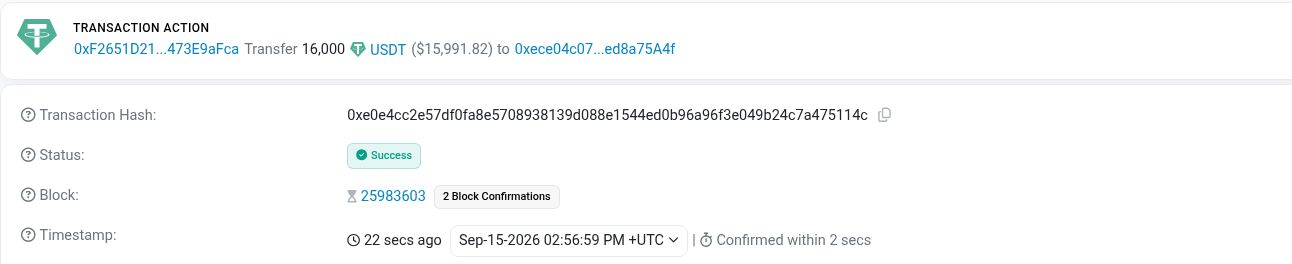
Take two people who have both been working in France for two years.
The first was sent there by a Chinese employer on a two-year assignment. He lives in an apartment provided by the company. His spouse and children stayed in China, and he plans to return to his old workplace when the assignment ends. He has made no arrangements to settle abroad permanently.
The second moved to France with his family several years ago. Both spouses have ongoing jobs there, their children attend local schools, and the family has a settled home and daily routine. Their property in China is rented out. They visit China mainly to see relatives; there is no overseas assignment scheduled to end with a return home.
Both can truthfully say they have been living abroad for years. But their circumstances point in different directions. The first person's stay is tied to a temporary assignment, while his family life and plans after the assignment still point to China. Two years away does not, by itself, establish that he has ceased to be a Chinese tax resident. The second has substantial evidence of a lasting move. That evidence cannot simply be disregarded because he still owns a property in China.
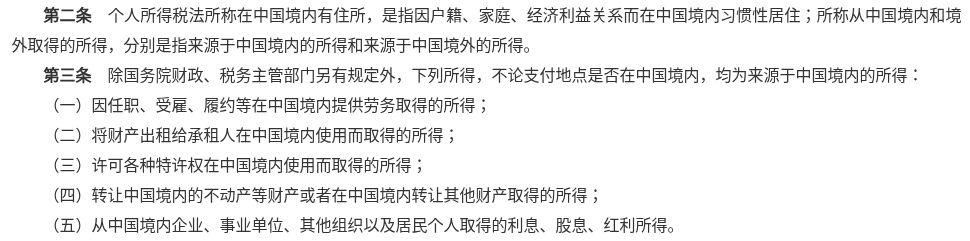
Chinese tax law uses a concept usually translated as “domicile”: habitual residence in China arising from household registration, family ties and economic interests. Owning a home is not the same thing as having a domicile for this purpose. Nor should the term automatically be given the meaning it has in another country's law.
What if one spouse lives in China and the other lives abroad? Does that automatically make the spouse abroad a Chinese tax resident?
You need to ask why they are living apart. Consider these two situations.
A husband goes to Canada for a three-year engineering assignment. His wife stays in China with their children. The family home is in China, the children are expected to continue their education there, and he plans to return when his contract ends. Most of his earnings support the household in China. His work has temporarily taken him overseas, but the family's underlying living arrangements have not moved. Taken together, those facts support the view that China may remain his habitual place of residence.
Now suppose the family has been settled in Canada for years. Both spouses have worked there, and the children have always attended school there. The wife's mother becomes ill, so the wife returns to China temporarily to care for her. Her husband and children remain in Canada. Their home, his job and the children's schooling are unchanged, and she has a clear plan to return. Her presence in China matters, but it does not, on its own, show that her husband's family life has moved back to China.
In both cases, the wife is in China and the husband is abroad. The reasons for the separation and the family's plans make the situations quite different. Those facts still need to be considered alongside the individual's other work, business and living arrangements; neither example is a universal test.
Economic ties need the same care. Asking whether someone sends money to China tells you very little without the context.
A person whose family is settled in Canada may send money to parents in China every month. That is evidence of supporting their parents. Compare that with someone who rents an apartment abroad but still runs a Chinese business every day, earns most of their income from that business, and has a spouse and children living in China. The second person's family and economic connections are substantially different.
Receiving a payment from China does not automatically make you a Chinese tax resident. Equally, changing the account that pays you does not change where your family lives or how you run your business.
Where does the 183-day rule fit in?
If you remain domiciled in China for tax purposes while on assignment in France, spending only 20 days in China during the year does not automatically make you a non-resident. The domicile question comes first.
If you have no domicile in China, your days of residence then matter. Under Chinese domestic law, a non-domiciled individual who spends fewer than 183 qualifying days in China during the tax year is a non-resident. At 183 days or more, that individual is a resident for the year.
For example, a non-domiciled person returning to visit family and deal with personal matters will get a different result with 70 qualifying days than with 190. The tax year runs from January 1 to December 31. You cannot combine the second half of one year with the first half of the next and treat that as a Chinese tax year.
Under Announcement No. 34 of 2019, a day counts toward this residence test only if a non-domiciled person spends the full 24 hours in China. Arrive on Monday evening and leave on Friday morning, and Tuesday, Wednesday and Thursday count. Monday and Friday do not.
Do not use that calculation indiscriminately to allocate your salary, though. Days of residence and days attributable to work in China serve different purposes. Under the relevant rules for non-domiciled individuals employed both inside and outside China, or solely outside China, certain days involving less than 24 hours in China count as half a working day. An arrival day excluded from the residence count does not necessarily mean that work performed that day has no Chinese tax implications.
Then there is the “six-year rule.” Some people take it to mean that leaving China for a little over a month every few years exempts all their overseas income.
First, check whether you qualify to use the rule at all. It is a special arrangement for individuals without a domicile in China. Someone who remains domiciled in China cannot obtain that treatment simply by taking a month-long trip abroad.
Suppose a non-domiciled individual spent at least 183 days in China in each year from 2019 through 2024, with no single absence exceeding 30 days in any of those years. They again spend at least 183 days in China in 2025. They cannot assume that their foreign income for 2025 remains exempt under the six-year concession.
Change one fact: in 2022, they left China for 45 consecutive days. That changes the calculation of consecutive qualifying years. In this example, eligible foreign-source income paid from outside China in 2025 may qualify for the exemption, subject to the applicable requirements and procedures.
The exemption does not cover everything a foreign company pays you. If the payment is for work you performed from an office in Shanghai, the location of the payer does not turn it into foreign-source income.
Which brings us to a separate question: where did you actually earn the salary?
Suppose a Singapore company pays you 8,000 USDT every month. You spend the first three months coding from your home in Hangzhou, then work on site in France for the remaining nine. The payer and receiving wallet stay the same; the place where you work changes. You cannot simply classify the entire year's pay as foreign-source salary. It needs to be allocated under the applicable rules by reference to the work you performed.
A bonus requires more than a look at the payment date, too. You complete a development project in China between January and June, move to France in August, and receive the project bonus in December. You are abroad when the money arrives, but the bonus rewards work done earlier in China. Project records and the bonus terms help establish its source. Proof that you were living in France in December does not answer that question.
The reverse is also true: a payment from a Chinese company is not automatically salary for work performed in China. If an ordinary employee works in France throughout the year and the Chinese company handles payroll, the actual duties and applicable sourcing rules still matter. Directors and senior executives may be subject to special rules, so their remuneration should not automatically be treated like an ordinary employee's salary.
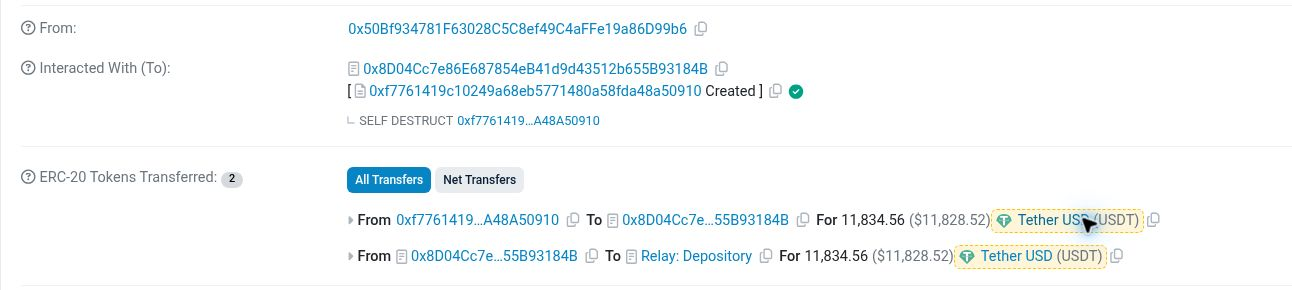
Once residence and the location of the work are clear, you can address the USDT payment itself.
A common assumption is: “I haven't sold the tokens or received any renminbi, so I haven't earned any income yet.”
Suppose your employer owes you 8,000 USDT for a month's work. You complete the work, the employer transfers the tokens, and you can use them. The fact that you have not converted them into renminbi does not establish that you have received no compensation. Chinese individual income tax rules recognise forms of economic benefit beyond cash.
That general principle does not mean there is a settled, uniform answer for the tax category, recognition date and valuation of every token arrangement. You still need to examine the terms.
One contract might promise a monthly salary of US$8,000, settled in USDT on payday. Another might promise 8,000 of a project's own tokens each month. The first starts with a dollar-denominated entitlement; the second depends on the value of a potentially volatile token. You need to understand how the dollar obligation was settled in the first case and establish the token's value in the second. Counting 8,000 units is not enough.
Ask whether the figure is gross or net. “8,000 before tax” is different from “you receive 8,000 after tax, and the company pays your personal tax separately.” In the latter case, the wallet receipt may not capture the full amount of compensation that needs to be considered. The employer's payment of your tax may also have to be included.
Valuation requires more than saying that one USDT equals one dollar. Keep support for the price used and the conversion into renminbi. This becomes particularly significant with an illiquid project token. A project may advertise a price of US$10 per token even though there are very few trades and a small sale would move the market sharply. Multiplying that quoted price by your entire allocation needs a defensible basis.
With token incentives, timing can be just as important as the number of tokens promised.
Suppose an employment agreement promises 100,000 tokens only after two years of service, with nothing payable if you leave earlier. Signing that agreement and later satisfying the conditions are different events. Compare that with an arrangement where the tokens have already been transferred to you but cannot be sold for a year. Your rights and restrictions are different again.
Look separately at the promise, vesting, any lock-up and actual delivery. A promise of 100,000 tokens does not necessarily make the entire amount income on the signing date. Equally, a lock-up does not automatically put all tax questions on hold. The documents need to establish what rights you acquired and when.
Your working relationship also affects how the income is classified.
If you work to the company's schedule, report to its managers and receive fixed monthly pay, employment income is the starting point. If you never joined the company and instead accepted an independent consulting engagement paid against deliverables, categories such as remuneration for services or business income need to be considered. Payment in USDT does not turn either arrangement into crypto trading income, and it does not justify applying a flat 20% rate without further analysis.
What happens after you receive the tokens is another question.
Suppose compensation has already been recognised under the applicable rules, and you then trade the tokens and lose half their value. That does not automatically halve your original employment income. Losing cash salary on a stock investment would not reduce the salary you earned, either. Any later disposal needs its own analysis, including whether it has tax consequences and how previously recognised value is treated as cost. The same amount should not be taxed twice, but employment income and investment results cannot simply be combined into one net figure.
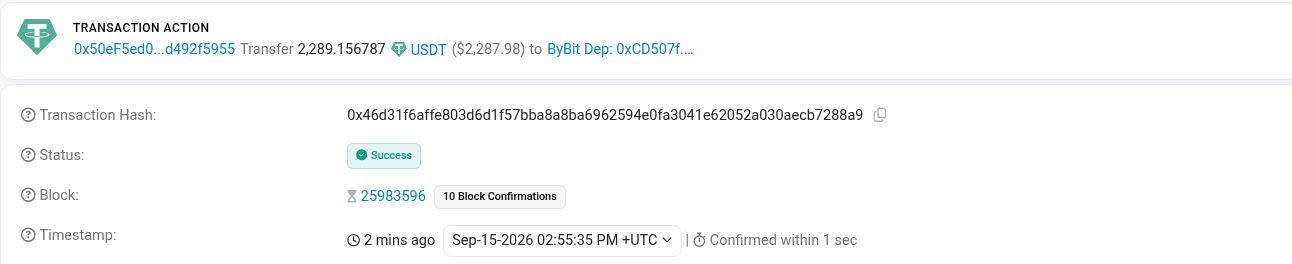
Transfers between wallets need to be kept straight as well. Your company pays you 8,000 USDT. You move it from wallet A to wallet B, then deposit it on an exchange. Three incoming entries do not mean three salary payments. Keep the linked records so you can show that the same assets were moving between accounts.
If a third party processes payroll and the sending address cannot readily be linked to your employer, obtain the employer's payment confirmation, payslip and transaction hash at the time. Explaining years later why an unfamiliar address sent you tokens every month is much harder if the project has closed and your contacts have disappeared.
What about the obvious objection: “I've already paid tax overseas. Wouldn't paying in China mean being taxed twice?”
Start by checking whose tax was paid.
If you own an overseas company and the company paid corporate income tax on its profits, that does not mean the personal income tax on your salary has been paid. The company and you are separate taxpayers. Its corporate tax receipt cannot simply be used to offset your personal salary tax.
If you personally paid eligible foreign income tax on the relevant income, the next questions are whether a credit is available and how much can be credited. Take a simplified example in which the Chinese foreign tax credit limit is RMB100,000 and all other conditions are met. Eligible foreign tax of RMB60,000 leaves a RMB40,000 difference in this example. If the foreign tax was RMB120,000, China does not refund the extra RMB20,000. Excess credits are dealt with under the relevant rules and may, where eligible, be carried forward for up to five years.
Do not confuse tax with transaction costs. An exchange withdrawal fee and a currency conversion service charge are not personal income tax and cannot simply be added to the foreign income tax claimed as a credit. Nor can a penalty for filing late overseas be treated as creditable income tax.
What if the country where you live does not tax the income? There is then no foreign tax payment on that income to credit. If you remain a Chinese tax resident and the income falls within China's taxing scope, an exemption abroad does not automatically give you an exemption in China.
Sometimes both countries regard you as a tax resident.
You might satisfy the residence test abroad while China also treats you as resident because of your domicile. You do not get to pick whichever jurisdiction charges less. The next step is to examine the relevant tax treaty or arrangement.
For example, treaty analysis may differ depending on whether you have a permanent home available in only one country or in both. A property in China that is rented to someone else on a long-term basis and unavailable for your own use is not automatically a permanent home available to you. If you have an available home in both countries, closer personal and economic relations may then need to be considered.
That analysis relates to some of the facts considered under China's domestic domicile test, but the concepts are not interchangeable. The precise sequence and outcome depend on the treaty concerned. A foreign tax residence certificate can support your position; it does not replace the analysis.
Finally, do not rely on what appears in China's individual income tax app to tell you whether you need to file.
If you earned foreign-source salary in 2025 that must be reported in China, the general filing window is March 1 to June 30, 2026. A foreign employer may not have submitted payroll information to China, so the income may not appear automatically in the app. That does not remove your filing obligation. Waiting for a foreign tax certificate is not a reason to set the entire filing aside, either: the return and any subsequent foreign tax credit claim need to be handled under the applicable procedures.
The tax residence information you give a bank or exchange also needs to reflect your circumstances. If you lived in China when you opened an account and later moved abroad, review and update the information as appropriate. You cannot simply delete Chinese tax residence to avoid information exchange. CRS and the crypto-asset reporting framework, CARF, concern identification, reporting and information exchange. They do not themselves determine how much tax you owe, and any exchange depends on the applicable rules and exchange relationships in effect.
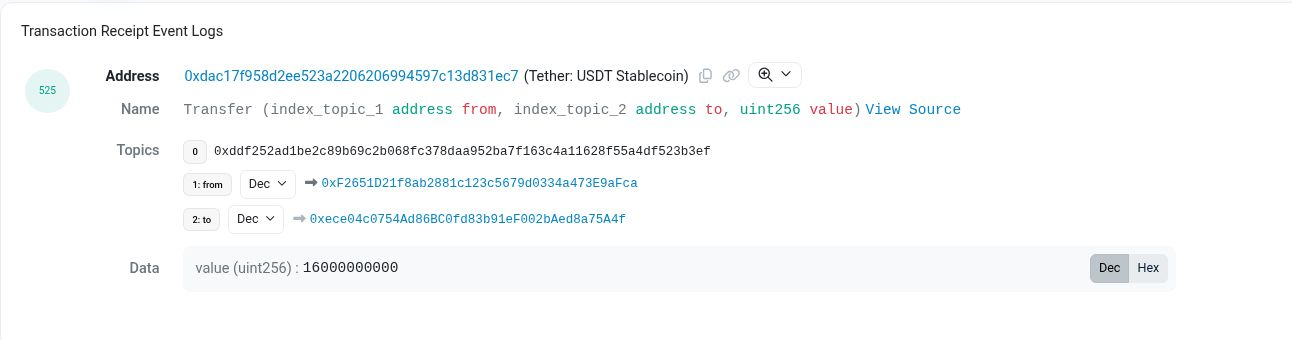
What you need is a set of records that explains your position: when you moved, why you moved, where your family lives, where the work was performed, what each payment was for, and where your overseas returns and tax receipts are kept. Your contracts, payslips, travel records and wallet history should tell a consistent story.
With those facts established, the original question becomes much easier to answer.
If you are a Chinese non-resident and your ordinary salary is genuinely for work performed outside China, Chinese nationality or a mainland bank account is not, by itself, a basis for taxing that foreign-source salary in China. If you remain a Chinese tax resident, you need to check the applicable exemptions, credits and treaty relief. If you worked in both China and another country during the year, separate the relevant periods and income under the appropriate rules.
Whether you work in France, Canada or somewhere else, and whether you are paid in dollars or USDT, those facts still matter. Your contracts, living arrangements and payment records can explain your tax position. “I moved abroad and never sent the money back” cannot do that on its own.
← Back to Upwell Insights