For many cross-border e-commerce businesses operating out of China, the structure is familiar. A mainland company buys the goods and exports them. A Hong Kong company purchases those goods, sells them to overseas customers and collects the proceeds. The mainland company claims export tax relief where eligible, while some of the profit remains in Hong Kong.
The questions used to be practical: Can we claim the tax refund? Will the bank open an account? How quickly can we receive payments? Now, with growing discussion of CRS 2.0, business owners are asking different questions. Will information about the Hong Kong account be sent to mainland tax authorities? Are annual audits and tax returns enough? Do we need staff in Hong Kong? Should the mainland company own the Hong Kong business through an outbound investment arrangement?
Those questions are connected, but they concern different rules. To understand what needs attention, start with the transaction itself: how the goods leave China, what the Hong Kong company actually does, and how financial account information is reported.
What does “0110” mean?
“0110” is the Chinese customs code for general trade. It identifies the customs supervision regime used for a transaction. It is not a tax rate, a tax incentive or a special channel reserved for e-commerce businesses.
Suppose a mainland trading company buys household goods from a Chinese factory and sells them to an overseas buyer. It exports the goods under the general trade regime. If the transaction meets the applicable requirements, the company may claim export tax relief.
Broadly, China’s export refund and exemption rules address VAT and, where relevant, consumption tax borne in the domestic supply chain. The treatment depends on the exporter, the goods and the applicable policy. Entering “0110” on a customs declaration does not automatically produce a refund calculated on the export price.
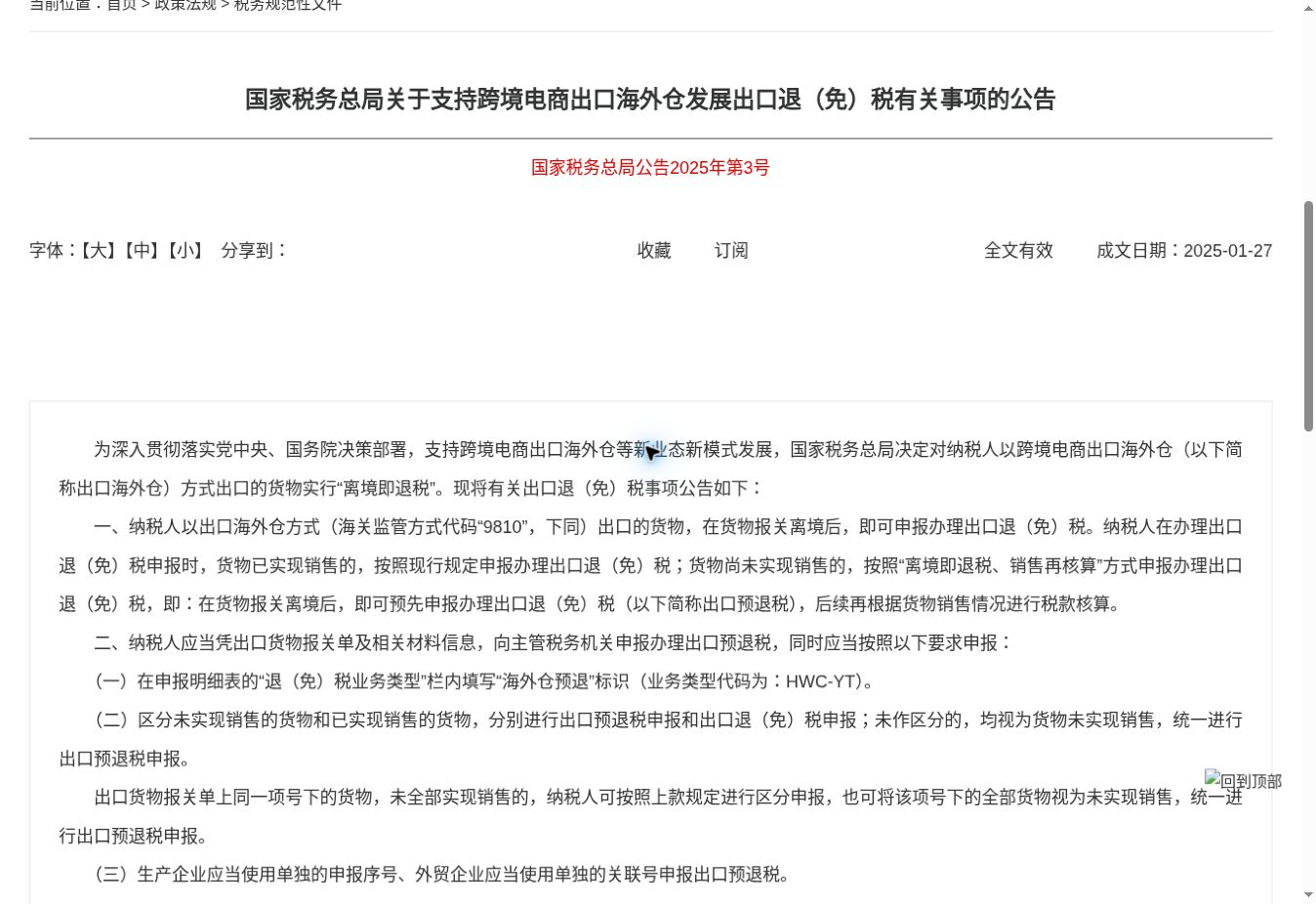
The underlying purchase and export must be genuine, and the relevant invoices, customs declarations, transport documents and payment records must meet the applicable requirements. General trade is also not the only regime under which export tax relief is available. Goods exported to overseas warehouses under code “9810” have their own arrangement allowing an advance refund after the goods leave China, followed by a reconciliation based on sales.
Why put a Hong Kong company in the middle?
Now follow the same shipment. The mainland company sells the goods to a Hong Kong company, which sells them to overseas customers. Depending on the commercial arrangement, the goods may travel directly to their overseas destination without physically entering Hong Kong. The contracts, ownership of the goods, shipping arrangements and payments still need to support what actually happens.
The Hong Kong company might negotiate overseas contracts, operate online stores, manage the brand, handle customer service and collect payments. It might also bear inventory, refund and foreign exchange risks. If it performs those functions and bears those risks, there is a commercial basis for allocating an appropriate share of the profit to it.
That is the logic behind the structure. The precise division of work will differ from one business to another.
A Hong Kong company is not, however, a legal prerequisite for claiming mainland export tax refunds. It is a choice about how to run the business. Nor can inserting a Hong Kong buyer turn an otherwise ineligible export into an eligible one.
Where does CRS come in?
Once sales proceeds accumulate in the Hong Kong account, the next question is usually who can find out about them.
CRS stands for the Common Reporting Standard, developed by the Organisation for Economic Co-operation and Development, or OECD. It addresses a longstanding problem in cross-border taxation: how does a tax authority obtain information about financial accounts held abroad by its tax residents?
Under CRS, reporting financial institutions carry out due diligence to identify tax residence and reportable accounts. They report prescribed information to their local tax authority. That authority then exchanges the information with relevant partner jurisdictions under the applicable exchange arrangements.
This helps explain why a Hong Kong bank asks for tax residence details, tax identification numbers and an entity classification when a company opens an account. Tax residence matters here. Citizenship alone does not settle the question, and opening an account in Hong Kong does not make its holder a Hong Kong tax resident.
What did the original CRS already cover?
The existing framework already covers financial accounts that fall within its definitions, including deposit accounts, custodial accounts, certain equity or debt interests in investment entities, and some cash-value insurance and annuity contracts.
For reportable accounts, the information can include the account holder’s identifying details, tax residence, tax identification number, account number and year-end balance or value. Depending on the account type, it can also include interest, dividends and gross proceeds from sales or redemptions of financial assets.
That does not mean every account reports the same income categories. Nor does it mean CRS transmits every bank transaction or e-commerce order to mainland China in real time. Gross securities sale proceeds are not the same as investment gains. A company’s account balance is not automatically its owner’s taxable income.
Still, account information can prompt further questions. A tax authority may compare it with returns and other records, and ask for an explanation where the information does not fit. An account associated with a supposedly inactive company, for example, may require a closer look if the financial information suggests otherwise.
The starting point is therefore not that Hong Kong accounts were previously invisible and will suddenly become reportable under CRS 2.0. Entity classification, tax residence and the identification of controlling persons of passive entities were already part of the framework.
What changes under CRS 2.0?
“CRS 2.0” is commonly used to describe the amended CRS, including the updates published by the OECD in 2023. The amendments respond to changes in financial products and seek to improve the completeness and usefulness of reported information.
For an e-commerce business owner, three points matter most.
First, the scope extends to certain digital financial products. The amendments bring specified electronic money products and central bank digital currencies within the framework, and address certain indirect exposures to crypto-assets through financial institutions and investment products. Definitions and exclusions matter. A product is not necessarily reportable simply because it is called a wallet; equally, being outside a traditional bank account does not establish that it is outside CRS.
Second, reporting becomes more detailed. Additional or more specific information includes account type, whether an account is new or pre-existing, whether a valid self-certification has been obtained, joint account status and the number of joint holders, and the capacity in which a reportable controlling person controls an entity. Some of the underlying identification obligations already existed. The change is partly about making more of that information reportable.
Third, the CRS amendments sit alongside a separate framework: the Crypto-Asset Reporting Framework, or CARF. CARF addresses reporting by relevant crypto-asset service providers in relation to covered transactions. It should not be conflated with CRS. Neither framework justifies a blanket statement that every USDT transaction or blockchain address is already being automatically reported worldwide.
Implementation dates differ by jurisdiction. Hong Kong’s 2026 legislative proposals and announced policy timetable envisage the amended CRS applying from 2028, with the corresponding first exchanges in 2029. Proposed legislation, enacted commencement provisions and operational requirements need to be checked separately. A future start date for exchanging the additional information does not suspend existing CRS obligations.
Does an actively trading Hong Kong company escape reporting?
This is where an apparently simple answer can be misleading.
CRS distinguishes between active and passive non-financial entities, usually called Active NFEs and Passive NFEs. A company carrying on a genuine trading business may qualify as an Active NFE, but the classification must be tested against the rules. Its name and the presence of transactions in its bank account are not enough.
One common route to Active NFE status requires both passive income and assets producing, or held to produce, passive income to fall below the relevant 50% thresholds. Other qualifying categories exist. An annual audit does not, by itself, establish either the CRS classification or the company’s tax residence.
The crucial distinction is between reporting the company and reporting its controlling persons. An Active NFE is generally not subject to the Passive NFE look-through rules for reporting controlling persons. That does not make the company’s own account categorically exempt from reporting.
Hong Kong’s Inland Revenue Department illustrates this in Example 5 of its published guidance. An Active NFE that is tax resident in another reportable jurisdiction is itself a reportable person, even though the financial institution does not need to look through it to identify controlling persons for that CRS report.
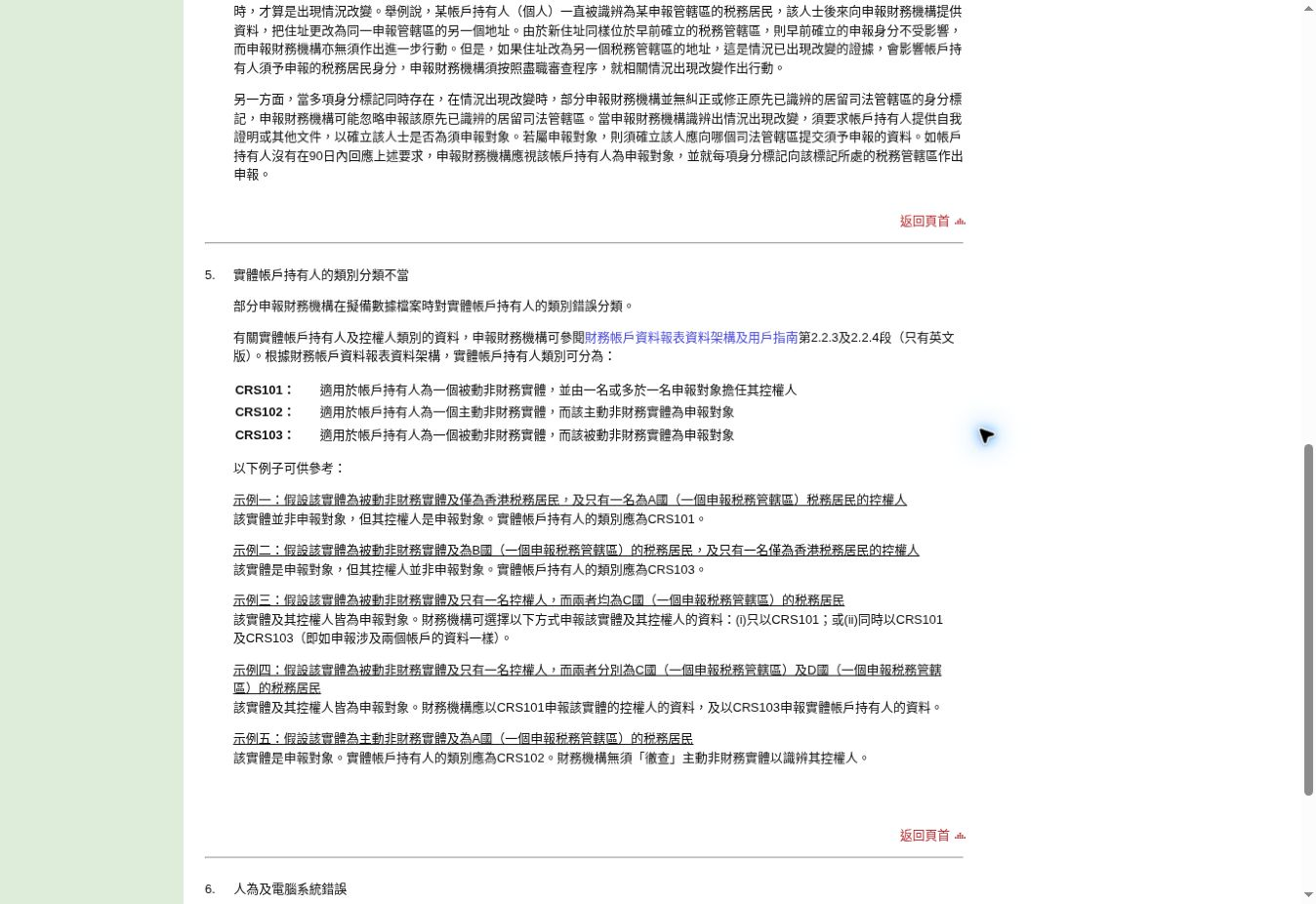
If a company is genuinely tax resident only in Hong Kong, holds its account in Hong Kong and qualifies as an Active NFE, having a mainland tax-resident shareholder does not ordinarily, by itself, trigger reporting to the mainland under the Passive NFE controlling-person rules. Each of those conditions matters. Separate bank requirements, including beneficial ownership checks, still apply.
What establishes that the business is actually managed in Hong Kong?
Consider an owner based in Shenzhen. The Shenzhen team selects products, negotiates with factories, buys advertising and sets prices. Recruitment is handled on the mainland, and the owner approves payments there. In Hong Kong, the company has a registered address, company secretarial support and an annual audit.
Those Hong Kong arrangements do not, on their own, establish that the business is managed there.
Mainland enterprise income tax rules also consider the location of an enterprise’s effective management body. A company incorporated outside the mainland may face mainland resident enterprise treatment if the body exercising substantive and overall management and control over its business, personnel, accounts and assets is located there. The analysis is fact-specific. Mainland shareholders alone do not settle it, and a Hong Kong incorporation certificate does not rule it out.
Useful evidence includes who makes significant decisions, where people actually perform their roles, how contracts are negotiated and how payments are approved. An office lease can support the picture, but renting a room cannot relocate the management of an entire business.
How much profit can reasonably remain in Hong Kong?
Common ownership does not allow the mainland and Hong Kong companies to choose their transaction prices without regard to the arm’s-length principle. The question is whether the terms and allocation of profit can be supported by reference to what independent businesses would agree in comparable circumstances.
If the Hong Kong company manages the brand, develops sales channels and serves overseas customers while bearing advertising costs, inventory risk and refund obligations, an appropriate profit allocation may have a sound commercial basis. If most of the work, costs and risks sit on the mainland, while Hong Kong merely receives payments, retaining most of the profit in Hong Kong needs a different explanation.
There is no universal “safe percentage” of profit that every e-commerce business can leave in Hong Kong. The analysis depends on the functions performed, assets used, risks borne and relevant comparables. A contract assigning risk to Hong Kong also needs to be consistent with how the arrangement operates in practice.
Is outbound investment compliance an alternative to Hong Kong substance?
No. ODI, or outbound direct investment, concerns investment abroad. A mainland company establishing or acquiring a Hong Kong subsidiary may need to meet applicable outbound investment and foreign exchange requirements. Whether the Hong Kong company has a real business operation is a separate question.
The mainland company can own a Hong Kong subsidiary through a compliant investment arrangement, and that subsidiary can also have staff, premises and genuine operations in Hong Kong. Those are not competing options.
Nor does direct individual ownership automatically remove every compliance requirement. The source of funds, funding route and any special-purpose vehicle or round-trip investment arrangements need to be considered. Simply deciding that ODI is expensive does not make Hong Kong operations a substitute for procedures that apply to the investor.
What if the company never pays a dividend or sends the money to mainland China?
Company profit and personal income are different. Retaining earnings to buy inventory, fund expansion or pay advertising costs may serve a genuine business need. It does not automatically mean the owner has personally received all those earnings.
But “no dividend, no tax issue” goes too far.
A Chinese tax-resident individual receiving dividends from a Hong Kong company generally needs to consider mainland individual income tax on foreign-source dividends, ordinarily at a 20% rate, subject to any applicable special treatment and foreign tax credit rules. Receiving the money in a personal Hong Kong account does not, merely because it stays offshore, mean no income has been received. Hong Kong profits tax paid by the company is also not automatically creditable against the shareholder’s individual income tax.
Undistributed profits can raise a separate issue. Article 8 of China’s Individual Income Tax Law allows tax adjustments in specified circumstances involving foreign enterprises controlled by resident individuals, alone or together with resident enterprises, in jurisdictions with significantly low effective taxation. The provision addresses failures to distribute, or reductions in distributions of, profits attributable to resident individuals without reasonable business needs. It does not automatically tax every Hong Kong company’s retained earnings, but it means that indefinite non-distribution is not a blanket exemption.
For a business already using this structure, the most useful first step is to trace one real order from purchase and customs clearance through delivery, collection and tax reporting. Identify who sold the goods, who collected the money, who incurred the costs and who retained the profit. Then compare that account of the business with the investment documents, bank self-certifications, audited accounts, tax returns and actual management arrangements.
Where changes or additional filings are needed, address them on the facts and under the applicable procedures. Do not try to make historic records look consistent by manufacturing contracts or retrospective evidence of Hong Kong decision-making.
A mainland general-trade exporter working with a Hong Kong sales company can be a legitimate commercial structure. CRS 2.0 changes parts of the reporting perimeter and the information reported. Effective management, transfer pricing and shareholder taxation already required attention. The practical test is whether, when asked why the profit remains in Hong Kong, the business can explain the transactions and tax treatment with records that reflect what actually happened.
← Back to Upwell Insights