A list of profitable wallet addresses is easy to mistake for a trading strategy. The harder questions are how each wallet made its money, whether the record is complete, and whether you could obtain anything close to its execution. Start by finding wallets worth observing. Decide separately whether copying their activity makes sense for you.
Use rankings to find leads
GMGN’s CopyTrade page includes a Rank view. Choose the same network and reporting window before comparing PnL, win rates, trade counts and scale. Today’s top wallet cannot be assessed on the same basis as another wallet’s thirty-day result unless you align the periods. The names and addresses in our screenshot are public examples from the page; we have not verified their owners and do not endorse them.
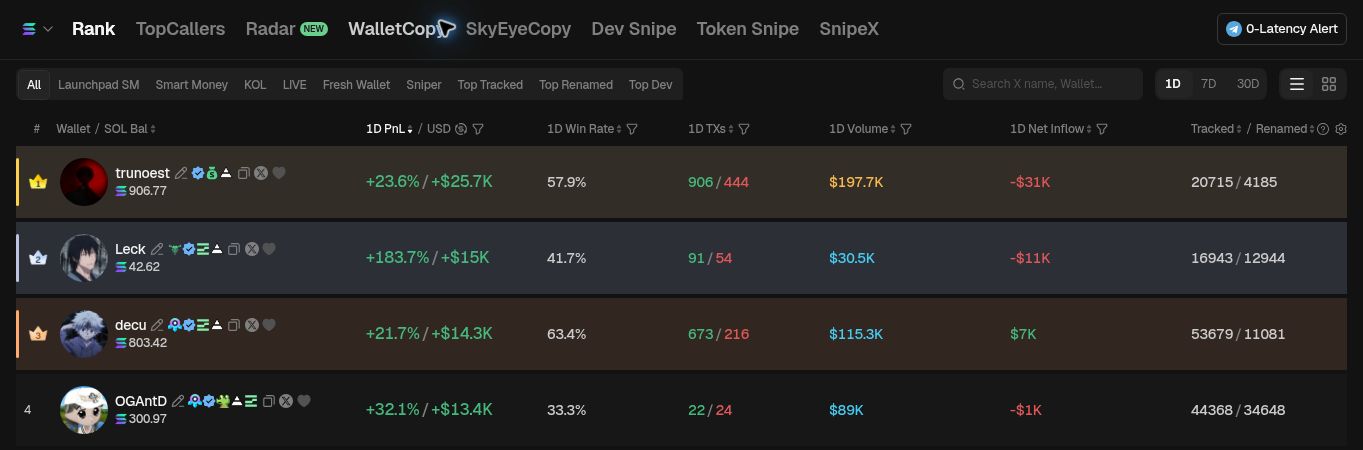
- Choose a consistent 1-day, 7-day or 30-day window before comparing wallets.
- Read PnL, win rate and trade count together. A high win rate does not show the size of gains and losses.
Consider a hypothetical wallet with ten trades: nine earn $10 each and one loses $200. Its win rate is 90%, but its combined result is a $110 loss. Another wallet might earn most of its profit from one exceptional token. Ask how broadly the gains are distributed, how long the record spans and how large the losses are. Win rate alone does not answer those questions.
Check how the profit was made
Where wallet or token details are available, distinguish realized profit from unrealized gains on positions still held. Review buying and selling activity and average entry and exit prices. GMGN documents these fields, although visible information can depend on the page version and account access. If you cannot inspect the full history, record that gap rather than assuming a consistent record. GMGN’s transaction-field guide
Establish whether tokens were bought in the market or transferred in from another address. Looking only at a later sale may understate the true acquisition cost. Where necessary, verify transactions in a block explorer and separate transfers, purchases and sales in your notes. Shared holdings across several addresses do not, on their own, prove common ownership. Public wallet data should not be treated as proof of a particular person’s identity.
Use Radar to compare selected tokens
If you are already researching several tokens, Wallet Radar can help find addresses that appear across that selection. The official guide describes categories for the most token matches, highest realized profit, earliest purchases and common holdings. Finding early buyers and finding addresses that still hold the same assets are different questions. Choose the category that matches the question. GMGN Wallet Radar guide
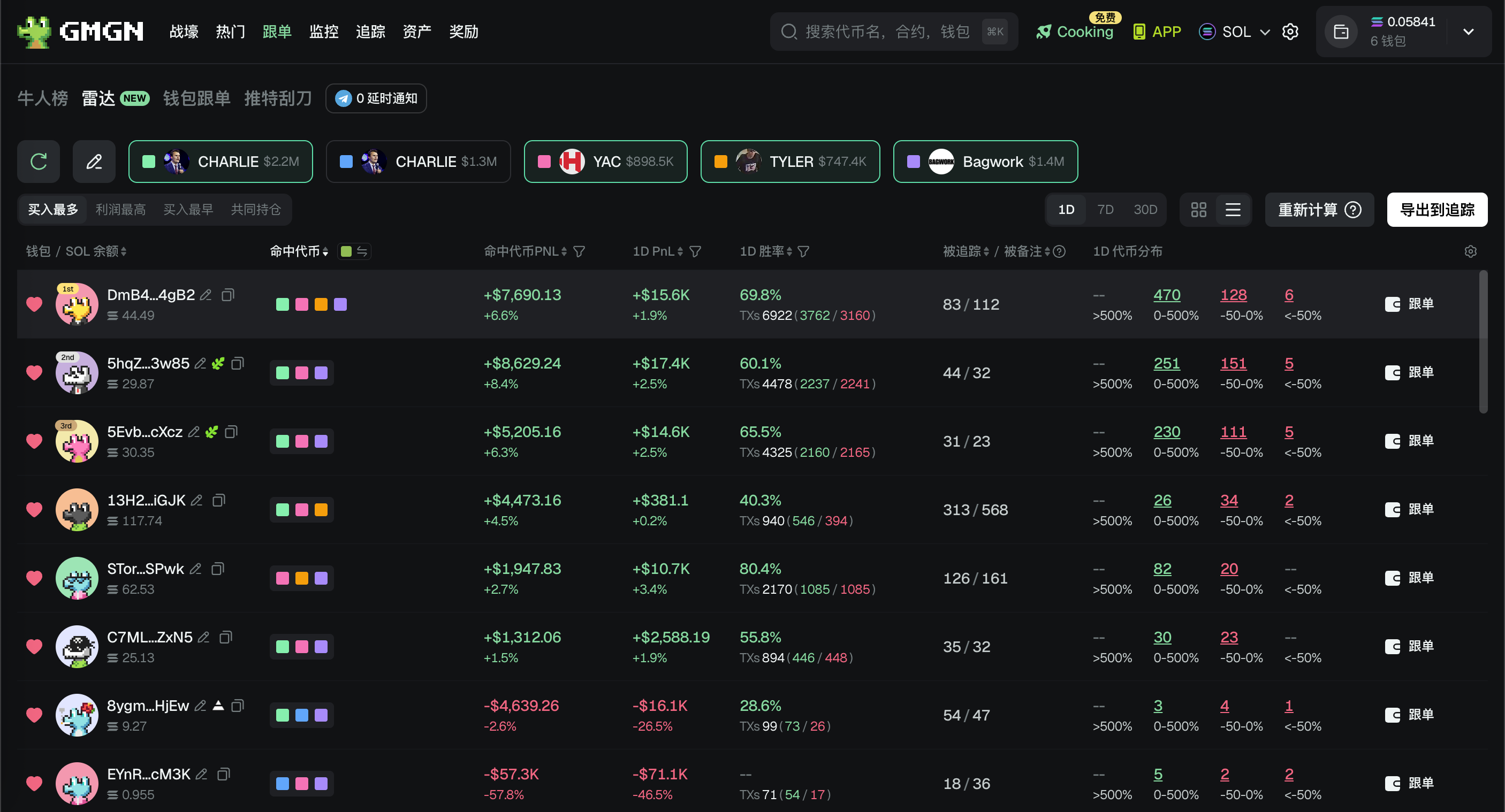
- The categories mean most token matches, highest realized profit, earliest purchases and common current holdings. They answer different questions.
- Recalculate refreshes the analysis. Export to tracking creates a watchlist; automated copying is a separate action.
Your selection can introduce its own bias. If you choose only tokens that have already surged, the results naturally emphasize wallets that benefited from those moves. Examine their other activity, including losing trades and positions they have not exited. The documentation also explains that a completed Radar calculation is not continuously refreshed: recalculation is needed. Yesterday’s result is not evidence of today’s holdings.
Track a hypothesis before committing funds
For each candidate, write a short reason for observing it, such as testing whether a lower-frequency approach remains consistent. Record when an alert appears, the price then available to you, liquidity and what eventually happens to the position. Exporting addresses to a tracking list or enabling alerts is distinct from authorizing automated trades. Observation should test your initial reason for selecting the wallet.
Finally, compare the wallet’s behavior with your own constraints. Could you review hundreds of trades a day? Could you tolerate its position size and worst losses? Would the price available after an alert leave enough room to cover all your costs? If those questions remain unanswered, the address may still be worth studying. That does not yet make it suitable for an automated copy task.
← Back to Upwell Insights