“I’m setting up a Hong Kong company in my own name. I’m not investing through a mainland business. Do I still need an ODI filing?” It sounds like a straightforward question. Yet one adviser may tell you a filing is mandatory, another may say individuals cannot use the corporate filing process, and a third may say there is nothing to worry about as long as the money is legitimate.
Owning a Hong Kong company without a corporate ODI filing does not, on its own, establish that a mainland resident has broken the law. But in 2026, a blanket assurance that individuals are outside China’s outbound investment rules is no longer tenable. Incorporating the company, meeting the investment requirements and transferring the money each raise a separate question.
To understand why the answers differ, it helps to look at how the rules developed. Outbound direct investment, or ODI, has traditionally been associated with mainland businesses expanding overseas: a Chinese company establishes a Hong Kong subsidiary, for example, or uses that subsidiary to invest in Southeast Asia. The Ministry of Commerce (MOFCOM), the National Development and Reform Commission (NDRC) and the foreign exchange authorities each have rules governing aspects of these transactions. This is why people often associate ODI filings with corporate investment.
There is a legal basis for that understanding. MOFCOM’s 2014 outbound investment measures were framed around enterprises established in mainland China. The NDRC’s 2017 measures, which took effect in March 2018, expressly excluded direct investment by mainland individuals overseas or in Hong Kong, Macao or Taiwan from their scope.
That exclusion explains why the corporate ODI process could not simply be applied to an individual setting up a Hong Kong company. It did not exempt individuals from every other rule. Personal foreign exchange rules already addressed overseas direct investment, while the State Administration of Foreign Exchange (SAFE) issued Circular 37 in 2014 to regulate certain offshore financing and investment arrangements involving special purpose vehicles.
There was also an important qualification in Article 63 of the NDRC’s 2017 measures. That article provided for the same measures to be followed when an individual invested overseas through a controlled offshore company, including a Hong Kong company. Direct personal ownership of a Hong Kong company and a subsequent investment by that company in a factory in Vietnam could therefore require different treatment.
The position changed again on 1 July 2026, when the State Council’s Regulations on Outbound Investment took effect. These introduced a framework at the level of a State Council administrative regulation, above the existing departmental rules, covering investment administration, investor services, protection of rights and legal liability. They expressly include resident individuals within their scope. An assessment made today cannot rest solely on an exclusion in the older corporate measures.
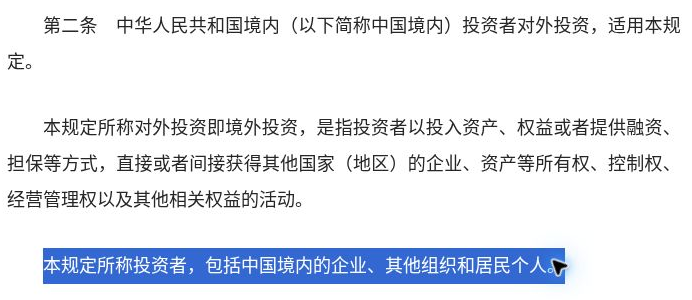
Does that mean every individual establishing a Hong Kong company must now complete the corporate ODI process? The new regulation does not, by itself, answer that question. Article 33 leaves the detailed measures for outbound investment by resident individuals and certain other investors to the relevant investment and commerce authorities. Being covered by the regulation and knowing which procedure a particular investment requires are separate steps in the analysis.
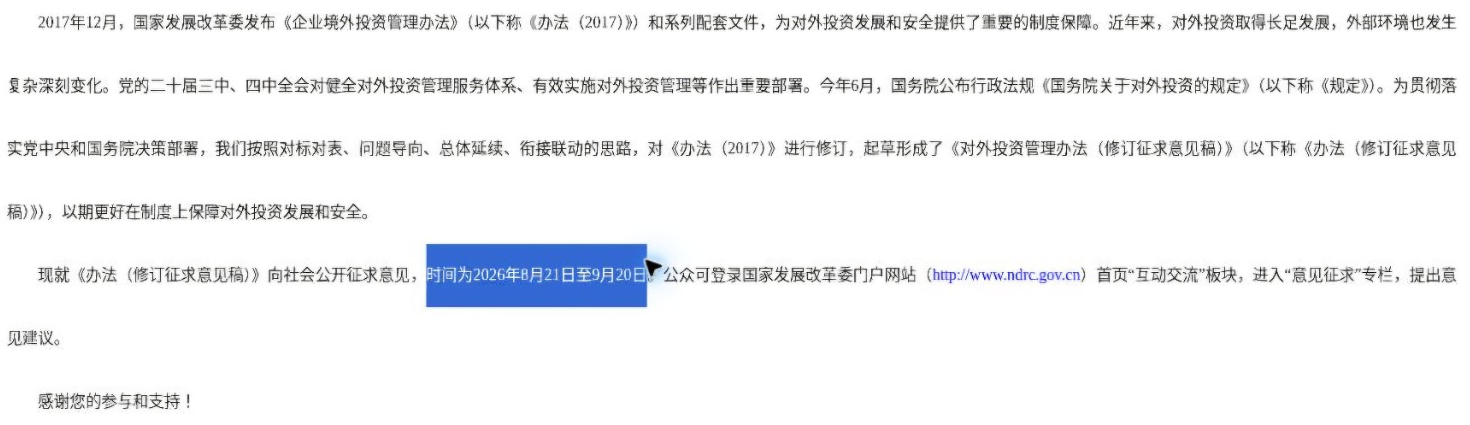
The timing matters here. As of 13 September 2026, the State Council regulation is in force, but the NDRC’s proposed revisions, published in August, remain open for public consultation. A consultation draft should not be treated as an effective rule. For an existing Hong Kong company, the requirements at the time of incorporation must also be distinguished from those applying to a later capital contribution or further investment. The new regulation alone does not establish that an earlier shareholding was unlawful.
| Development | Why it matters to individual investors |
|---|---|
| 2014: MOFCOM’s outbound investment measures | The framework focused on mainland enterprises. Its procedures could not simply be transferred to an individual investor. |
| March 2018: the NDRC’s 2017 measures take effect | Direct investment by individuals was excluded from these measures. Further investment through a controlled offshore company was to follow the same measures. |
| July 2026: the State Council regulation takes effect | Resident individuals are expressly included, with detailed rules to be made by the relevant authorities. |
| August 2026: the NDRC publishes proposed revisions | The proposals seek to implement the new framework. They remain a consultation draft as of 13 September 2026. |
The next question is how the company will be funded. If the money is in mainland China, the annual US$50,000 quota for personal foreign exchange purchases does not, by itself, authorise an individual to fund an overseas company. The stated purpose of the purchase must be accurate. The personal foreign exchange application prohibits false declarations, splitting purchases across other people’s quotas and using the facility for capital-account transactions that have not been opened to individuals.
Incorporating a company does not give its shareholder permission to remit the investment funds. Nor does converting renminbi into US dollars while the funds remain in the mainland resolve the issue. The investment purpose and the permitted route for transferring the money still need to be checked.
What if the money is already overseas? Income lawfully earned and retained abroad presents a different funding situation because there is no new transfer out of mainland China. But the absence of a mainland remittance does not settle the requirements for the investment itself.
SAFE Circular 37 is particularly easy to misunderstand here. It addresses foreign exchange registration for specified arrangements in which mainland residents use special purpose vehicles for offshore investment and financing, including structures involving investment back into mainland China. A resident using interests in a mainland business to establish an offshore financing structure should examine it closely. The circular also addresses contributions made with lawfully held overseas assets or interests, so the location of the assets alone does not rule out its application.
Circular 37 registration is not a universal filing for anyone opening a Hong Kong company. Whether it applies depends on the structure and purpose of the arrangement. It should not be treated as a general permission to move investment funds overseas either.
| Your proposed arrangement | What needs to be checked first |
|---|---|
| A mainland company establishes a Hong Kong subsidiary | The corporate outbound investment approvals, filings and foreign exchange procedures applicable to the project. |
| An individual invests directly using lawful overseas assets | The individual investment rules in force at the relevant time, the source of the assets and any applicable special purpose vehicle registration requirements. |
| An individual funds the company with money held in mainland China | The investment purpose and a permitted remittance route. The personal foreign exchange quota is not an investment allowance. |
| A Hong Kong company controlled by an individual invests in another country | The rules on further overseas investment through a controlled company. The identity of the ultimate shareholder does not settle the issue. |
Using an underground bank, inventing a trade transaction or borrowing relatives’ foreign exchange quotas does not become compliant because the eventual purpose is to start a business. Equally, a legitimate source of funds is only one part of the assessment. Investment procedures, the funding route, business operations and tax obligations still need to be considered.
If the longer-term plan is to place the shares in a family trust, the next questions concern tax costs and what the trust would do for the family. Our article on putting Hong Kong or offshore company shares into a trust looks at those decisions.
Before asking whether you need “an ODI filing”, set out who is investing, which assets will be used, where those assets are held and what the Hong Kong company will do next. Will it run a business in Hong Kong, invest in another country or invest back into mainland China? Those facts determine which rules need to be examined. A useful answer has to address the transaction you are actually planning.
If you already have a proposed structure and funding plan, contact us with a brief outline of the investor, the source of the funds and what the company will do.
← Back to Upwell Insights