You took out a large life insurance policy overseas years ago. Its cash value has grown, and you’ve been thinking about putting it in a trust for your children. Then you hear about China’s new offshore trust tax rules. Is the trust still worth paying for? Would it be simpler to leave the policy as it is?
Start with what you want the arrangement to do. If you simply want your children to receive the money in installments, the policy may already offer that option. If someone will need to manage the money and make decisions for your family over many years, a trust deserves a closer look.
The discussion here assumes that the policy owner is a mainland Chinese tax resident.
On 24 July 2026, China’s Ministry of Finance and State Taxation Administration issued Announcement No. 21. Under its rules, transferring an asset into an offshore trust can create taxable income based on its market value, less its tax basis and allowable expenses. You can face a tax bill without selling the policy or receiving any cash. A policy’s valuation and tax basis need supporting records; projected returns in a sales illustration are not a substitute.
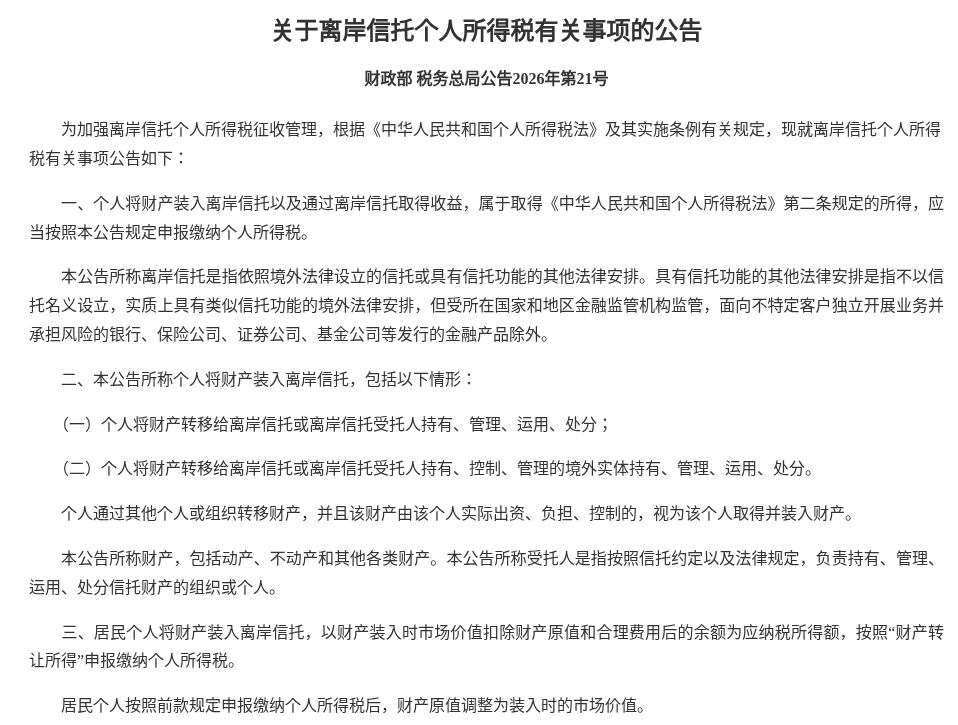
Income earned within the trust must also be reported annually, even if it has not been distributed. That does not mean every increase in a policy’s estimated value is automatically taxable. Policy dividends, surrender proceeds and insurance benefits require separate analysis. Income already taxed under these rules is not taxed again merely because it is later distributed.
For an older policy that has grown substantially, I would work out the transfer tax and ongoing costs before changing anything. Adding a trust does not automatically improve the arrangement you already have.
Now consider how you want your family to receive the money. Perhaps your concern is straightforward: your child is too young to handle a large payout. You worry about expensive purchases, poor investments or someone talking them into handing it over. You would rather they received a regular amount for living expenses. Before paying for a trust, check whether the insurance contract can do that.
The Bank of East Asia’s description of AIA’s ProsperLife Insurance Plan, for example, includes an option to pay death benefits monthly, quarterly, every six months or annually. It also allows the first and last payment dates to be specified, subject to the policy terms. These features let the owner set a payment schedule within the options the contract provides.

But what happens if your child later becomes seriously ill and needs more than the scheduled payment? Who decides whether to release additional funds? What if an elderly parent needs care, or your children have very different financial needs? If the policy’s terms cannot accommodate those circumstances, it may be worth appointing a trustee to manage the proceeds and make distributions under agreed terms. That is a concrete reason to consider a trust.
There is also a distinction that often gets lost: transferring ownership of a policy is different from arranging for a trustee to receive the eventual payout.
In one arrangement, the trustee becomes the policy owner. In another, you keep ownership and name the trustee as the beneficiary who will receive and manage the insurance proceeds. If you still own the policy and retain rights such as surrendering it or borrowing against it, you cannot assume that changing the beneficiary has put its cash value beyond your creditors’ reach. Both arrangements may be described as insurance trusts, but they need separate legal analysis.
Even a transfer of ownership does not guarantee protection from creditors. Under section 60 of Hong Kong’s Conveyancing and Property Ordinance, a disposition of property made with intent to defraud creditors can be challenged by a person prejudiced by it. If debts have already arisen and a creditor is pursuing you, transferring a policy to a trustee is not something you can assume will defeat the claim.
The legal position depends on where the funds came from, when the arrangement was established, whether ownership was effectively transferred, what powers you retained and which law applies. If someone promises that the trust will protect the policy from every possible claim, ask them to explain the legal basis for that promise.
Nor would I draw a fixed line and say that only exceptionally large policies justify a trust. A large policy with straightforward distribution needs may require no additional structure. A smaller policy might be an important source of support for a family member who needs lifelong care, or for relatives who cannot manage the money themselves. The amount matters, but so does the job you need someone to do.
A trust brings setup costs, continuing administration charges and potentially legal and tax advisory fees. Those costs can take a disproportionate share of a smaller fund. Ask a practical question: what will those fees buy your family that the policy alone cannot provide?
Before changing ownership, put the policy documents, premium and withdrawal records, current cash value statement and proposed trust deed side by side. Work out who should receive the money, when they should receive it and who will be responsible for managing it. Then assess the tax cost and legal effect of the arrangement. A tax headline alone is no reason to surrender a policy, transfer it or dismantle an existing trust.
← Back to Upwell Insights