When your bank account was first frozen, you may have expected to provide your records, answer a few questions and regain access within a few months. Six months later, transfers still fail. Each call brings the same answer: “We are still checking.” The hardest part is often not knowing what, exactly, you are waiting for.
Start by asking the bank for the account's current freeze details. Information you received six months ago may no longer describe the restriction in force today. The original freeze may have been extended, a separate freeze may have taken effect, or the bank may have kept its own transaction restrictions after the police freeze ended. This article concerns accounts in mainland China frozen in police criminal investigations. Civil court asset preservation, judgment enforcement and exchange account restrictions follow different rules.
Six months is not necessarily the end of a freeze
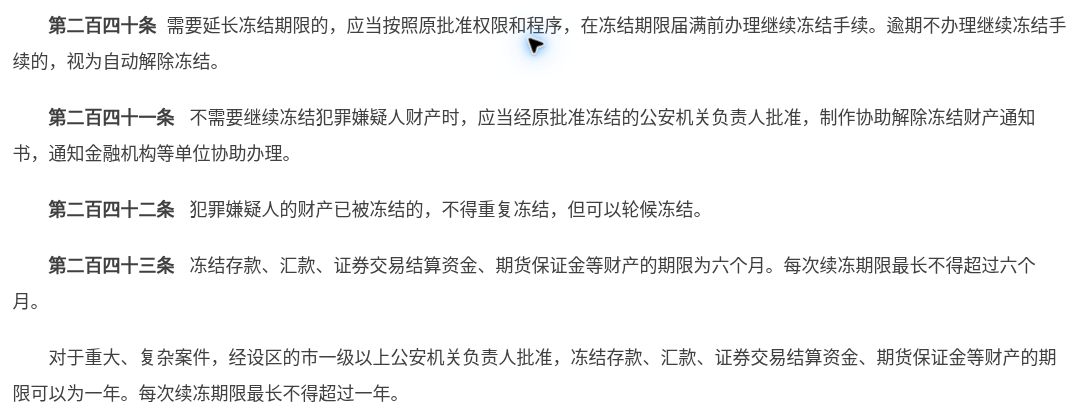
The six-month rule needs context. Article 243 of the Rules on the Procedures for Handling Criminal Cases by Public Security Organs sets a six-month period for freezing deposits, remittances and certain other financial assets. It also allows extensions of up to six months each. In major or complex cases, approval from the head of a public security organ at or above the level of a city divided into districts permits a one-year period, with extensions of up to one year each. These are limits on individual freeze periods and extensions, rather than a six-month cap measured from the first freeze.
An extension still requires the proper procedure. Under Article 240, the authorities must follow the original approval requirements and complete the extension before the existing period expires. If they fail to do so, the freeze is deemed automatically lifted. The useful questions are therefore when the current period ends, whether an extension was completed in time, and what now authorizes the restriction. Not receiving a phone call does not establish that there was no extension. Equally, “the investigation is ongoing” does not, by itself, explain whether the required procedure was followed.
Find out which restriction is in force today
Ask the bank to identify every freeze or restriction currently affecting the account: the issuing authority, the start and end dates, the amount affected and the account functions that remain unavailable. Request any available reference numbers and official contact details as well. If branch staff cannot answer immediately, ask them to refer the inquiry to the team that handles official account inquiries and freezes, and retain the service reference. The bank can only disclose information it is legally permitted to provide; this is a request for account status, not access to the criminal case file.
Three situations require different follow-up. If the original police authority extended the freeze, the inquiry remains with that authority. If another authority's queued freeze took effect when the first ended, you need to contact the authority now responsible. The rules prohibit duplicate freezing of already frozen property but allow a subsequent freeze to wait in a queue. Finally, a police freeze may have ended while the bank continues to restrict online or other transactions outside the branch. That calls for the bank's own review process, which we explain in why a Chinese bank account may still be restricted after it is unfrozen.
If the bank and the police give different answers, compare the account details, reference numbers and dates before assuming that either side has failed to act. Ask whether they are referring to the same freeze and whether the release instruction was received and implemented. “The police say it is unfrozen, but the bank says it is not” leaves too much room for two people to be discussing different restrictions.
You have submitted your records. What should you ask next?
Submitting documents three months ago does not tell you how far the review has progressed. Give the date and method of submission, then ask whether the documents reached the right team. Ask which payment or factual issue still needs clarification, whether you can provide any further original records, and how those records should be submitted. Investigators may be unable to disclose parts of the case, but these questions can still help establish whether your submission was received and what you can usefully do next.
Consider a hypothetical export transaction. An overseas buyer places an order but arranges for a third party in mainland China to pay you. After the account is frozen, you submit the contract and shipping records. Those documents may establish that goods were ordered and shipped without explaining why this particular person paid you or which order the deposit covered. The missing evidence may be the full correspondence arranging the third-party payment, details of the payer, the bank's payment record, and a clear match between the order, amount and date. A real sale does not automatically answer every question about the money received.
For each disputed receipt, provide a short explanation with the original records needed to check it. An organized submission is easier to review than dozens of screenshots without an index. Keep a copy of everything you submit, together with the date, delivery method, file names and any response. Explain gaps honestly; never recreate messages or fabricate receipts to make the file look complete. If you are still gathering records, the evidence-preservation and account-status sections of our guide to the first steps after a crypto-related bank freeze provide a starting point.
What if the only answer is still “under investigation”?
Once you understand the current restriction and the payments in question, you can put a specific request in writing. Identify the freeze you want lifted, the funds affected, why you believe those funds are unrelated to the case and the evidence supporting that position. Where only part of the money is disputed, you can also ask the authorities to distinguish the remaining funds and review the scope of the freeze. Whether release or a narrower restriction is appropriate depends on the established facts and applicable rules, not simply on how you have labelled entries in your bank statement.
Article 145 of China's Criminal Procedure Law requires the relevant seizure or freeze to be lifted within three days once the property has been established to be unrelated to the case. That condition matters. The three-day period does not start when you post your documents. A request explaining why the evidence establishes that particular funds are unrelated is more useful than a demand for release within three days of submission.
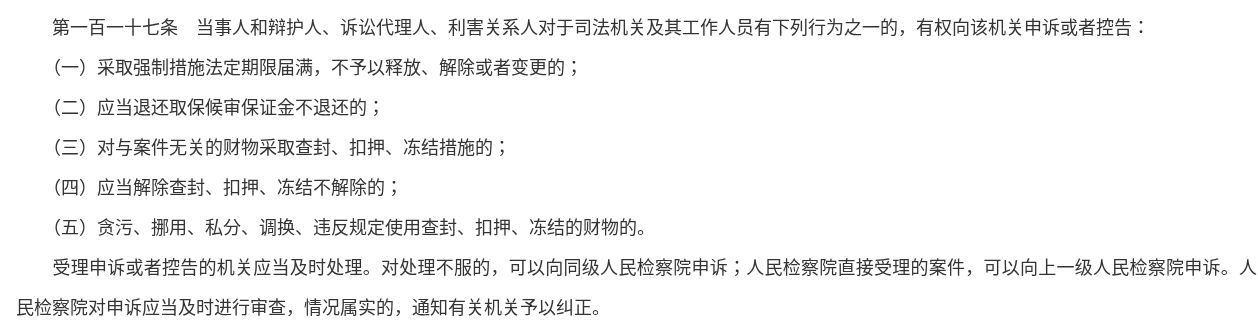
Article 117 provides a complaint procedure for, among other things, freezing property unrelated to a case or failing to lift a freeze when it should be lifted. A complaint is first made to the authority responsible for the conduct. If you disagree with its handling of the complaint, you may complain to the people's procuratorate at the same level. For cases handled directly by a procuratorate, the route is to the procuratorate at the next higher level. Identify the measure or decision you challenge and support the complaint with facts and records. Continued loss of access, or a reply that has not yet arrived, does not by itself establish that the freeze is unlawful.
What if you are told to repay money to secure release?
After months of waiting, an offer to resolve the freeze through repayment can sound appealing. Before acting, establish which payment is in question, the legal basis and nature of the proposed repayment, the supporting documents, and the authorized recipient. Ask which particular restriction would be lifted and whether other freezes or bank controls would remain. A payment does not automatically remove every restriction on the account, and an oral assurance does not establish that any criminal exposure has ended. We discuss these questions in what to do if police ask for repayment after a USDT-related bank freeze.
Before your next call, bring together the current freeze details, the records for the disputed receipts, your previous submissions and the responses received. You can then ask about a specific unresolved issue: an extension that needs review, a payment that still needs explaining, or a bank restriction that remains after police release. Those facts will help determine the next step more reliably than the number of months the account has been frozen.
← Back to Upwell Insights